onsdag 29 januari 2014

Charles the Great

.
Outside the Notre- Dame de Paris stands Charlemagne statue

Today it is 1200 years since Charles the Great died ,
 the man who broke with the misery that reigned in Europe since the 100 's,
with pestilence , crop failures and divisions between different ethnic groups.

 Between 748 and 814  Charlemagne ruled and with him came a new start
 for the economy and politics and culture. Charles learned to read as an adult and
because he revived Latin, he influenced the languages ​​of Europe and the education sector,
 more than any other .

 His empire stretched from northern Spain to Hungary, from the Danish border to northern Italy.
 One of his defeat was the Spanish campaign of 778, in the battle against saracenes .

 In a previous post I wrote about Roland songs that portray this war and
 also talks about Count Ogier , our  Ogier the Dane  who fought in this battle.
 (Ogier the Dane sits down at Kronborg casemates , in Elsinore and sleeping. ,
 The day Denmark is in danger he will rise up and save her. Such is the myth .
 The myth also says that Ogier the Dane was the son of Gudfred , king of Denmark,
who fought against the Franks
Ogier the dane was captured and had to fight with Charlemagne against the Saracens in Spain .
Here he showed such courage that Charlemagne set him free ,
Ogier wandered on foot back to Denmark , and sat down and fell asleep where today finds the statue. During World War II , during the German occupation of Denmark,
was  one of the resistance movements called Ogier the dane  But did he really exist ?
In  the Roland song he is  mentioned a few times as Count Ogier . Roland song is a French hero song, the oldest preserved , the oldest manuscript  from the 1100s ,
 but since Charlemagne's war against the Saracens took place in 778,
 it has probably been sung and written  before.
 Leif Duprez and Gunnar Carlstedt has done the first metrical translation of Roland Song to Swedish  I started looking for where Count Ogier  is mentioned , but could not stop reading , an amazing story . Recommended )


 Christmas Day in the year 800 Charles the Great was crowned emperor by Pope Leo III in St. Peter's Basilica . The plate he knelt on , it can be seen just inside the church . A large round plate which was near the altar in the first St. Peter's Basilica .


 Because Charles the Great encouraged  reading and writing  properly, the  universities arosed, and the writing , the Carolingian minuscel,  which  became the typeface antiqua,  is available today
in our computers,  as Times New Roman.

måndag 11 november 2013

Goosedinner in Scania


In Sweden, Saint Martins day is celebrated by eating goose.

November is the time for the slaughter of the geeses.

It is quite a job to serve a goosedinner. I myself am from Scania and it is a yearly tradtition
in our family to eat goose in november. It takes several hours to roast the goose and I cook the dish myself.
Usually it weighs  9 to 10 pounds and I stuff the goose with apples, prunes and bread.
Normally it takes 4 hours to roast, and with preparation and time for the dish to res´t a little while, I would say that it takes  6 hours before it is ready to be served.
It is served with potatoes, cabbage, Brussels sprouts, apple sauce and a sauce made with madeira and sherry.

The story of Saint Martin and the geeses tell us that Martin was trying to avoid beeing a bishop and hid among the geeses. They made a lot of noice and revealed him. Another tale of him, was that he gave his cloak to a poor man. The latin word för cloak is pallium, from which palliative care is named.
Saint Martin was the first palliative giver. Martin came from Tours in France and Saint Martins day was an important mediaval feast day.

After the gees we eat a cake, Spettekaka, meaning it is baked on a spit. The batter is poured on for a long time, 24 layers and it must dry between each layer. The cake is very sweet, crisp and tasty
You can see a part of the baking in this film
http://youtu.be/4E3bq9mZvKc

tisdag 5 november 2013

Biedesign- Storytelling textiles

Visit Katja Bie at Kronborg in Elsinore during the Christmas Fare
.It take place at the Kronborg galleries during two first weeks in december
You can buy a silkkimono there,
Visit her website: http://biedesign.dk/uk/

söndag 9 juni 2013

A royal summerwedding


A lovely royal summerwedding in Stockholm. A sunny, warm day and many swedes had come to Stockholm to see a glimps of princesse Madeleine and her husband Chris O' Neill.

The wedding took place in the "Slottskyrkan" The Castle of Stockholms own church
Children from Adolf Fredriks musicschool sang and carried flowergarlands.

Many guests from the european Royal families and many guests from all over the world, Japan , USA and India


torsdag 6 juni 2013

The National Day and the swedish flag


Today on the National Day in Sweden, we hoist our flag, with the same colours as the Scanian rapefields and the bluer sky. These yellow and blue hues were decided in 1906, after that the consul
Oscar Trapp, from Helsingborg, had visited a museum in Holland and seen an old flag from 1658.
Earlier the hues were darker.

The National Day in Sweden is celebrated because in 1523 Gustav Wasa became king of Sweden.
Before 1983 it was called the Day of the Swedish flag and became a holiday first in 2005.


tisdag 4 juni 2013

Around the Sound

Welcome to Scania and Seeland

http://runtoresund.skane.org/content/welcome-scania-and-zealand

Her You can read about different excursions in two countries, Sweden and Denmark

måndag 25 mars 2013

Happy Easter

                          Eranthis hyemalis

This Easter in Scania will be quite cold, just  23 to 32 degrees fahrenheit, some snow on Good Friday and some sunshine.

This flower on the picture, winter aconite and snowdrops  are the only one I have seen in Helsingborg.

At Easter many children dress like witches and eat a lot of candies.

The Easter Bunny, that originally comes from  Germany are hiding candies in an easter egg

by some families.

The christian influence over this period of laborfree days has diminished.

In the churches, thera are of course, concerts and church services.

During the mediaval times, the churches were decorated with palmleaves.

We often bring in branches of for example willow to decorate our homes.

The custom of painting the eggs, and make the Passover meal more festive, You can find all over Europe. It b popularecame popular in the Nordic countries in the 1700s


måndag 18 mars 2013

The Viking Disease

A disease, very common on Island and in the north of Europe goes under the name of "The viking disease. Officially the name is Dupuytrens contracter and is a contracture of the fingers, often the ringfinger and little finger is bent towards the palm of the hand. 9 out of 10,  who gets thís disease are men, often after 40 years of age. It is inherited and uncurable.

Prince Joakim of Denmark has done an operation, which is one of the ways to handle the disease.
8 % of the Swedes have it, so perhaps they are of Viking origin.


lördag 29 december 2012

Princesse Estelle of Sweden

 
                           Prinsesse Estelle, born in february 2012 is enjoying her first Christmas.

Thomas Becket


 In Lyngsjö church in Scania You find a baptismal font from the 1200s,  showing the murder of Thomas Becket, archbishop of Canterbury.

The motif is unique in the Northern Countries.

Thomas Becket  belonged to  the cistercienserorder and became Archbishop and then came into conflict with King Henry II. Four of the king's men killed him in the cathedral December 29, 1170 when Thomas was on his way to celebrate Vespers.

The news of the murder spread rapidly across Europe and Thomas was canonized already in 1173 by Pope Alexander III. His remains were removed from the cathedral and burned when Henry VIII broke with the Pope and became head of the Church.

Pålsjö Churchyard in Helsingborg with the War cemetery

During the second world war, the allies airforces and greman ariforces flew over swedixh territory.
In 1942 the brittish airfroces bombing increased agaisnt Germany. they flew from England, north of Denmark, in on swedich territory to reach Germany..

 
36 brittish, 9 canadian and 2 australian soldiers/pilots
who crashed close to the Sound, are burried here
on the War Cemetery at Påsljö cemetery

tisdag 2 oktober 2012

Dietrich Buxtehude


Dietrich Buxtehude, the famous organist, worked both in Saint Mary's church on Helsinborg and in Saint Mary's church in Elsinore. The family came originally from Buxtehude, but lived in Oldesloe (today Bad Oldesloe) at the 16th. century, His father first wnet tol Helsingborg, he is written as organsit in Saint Mary's organ in 1641. At this time Dietrich was born
 The family went to Denmark and Elsinore where he was organist  in the Cathedral of Elsinore.
Saint Olai church. They lived in a small , today yellow house, at Saint Anne's Street. While in Elsinore. Dietrich Buxtehude became organist first in Helsingborg from 1657, at the age of twenty to 1660. From 1658 Scania belonged to Sweden and perhaps that 's the reason for him to go back to Elsinore
Saint Mary's church was a german church during this time.
Dietrich Buxtehude waas very popular and became godfather to many children in Elsinore

1668 he went to Lübeck and got the post of organist in the Saint Mary's church.
He had to marry the former organist's daughter to get the post. The couple got seven girls, four of them became adults.

Johann Sebastian Bach walked all the way fro m Lüneburger Heide to Lübevck , just to listen to Dietrich Buxtehude playing the organ.

Dietrich Buxtehude died 1707 and was buried in Marienkirche (Saint Mary's church) in Lübeck.

torsdag 27 september 2012

Shakespeare and Kronborg Castle


"To be or not to be, that is the question........"


We all remember the words of Hamlet, and the play that takes place on the Kronborg castle.
There are no evidences that Shakespeare ever went to Elsinore to see the castle.
 King Frederik II loved banquetes, music and theater. He invited english actors and musicians to Elsinore to entertain at the court.  They lived on the Bramstraede.
For the building of the Kronborg Castle he invited german and dutch craftsmen and artists.
Elsinore was during the 16th and 17th century a cosmopolitical city.

Here came sailors, seecaptens, actors, craftsmen and merchants from all over Europe.
The castle is today on the World Heritige list of Unesco and over 200.000 turists visit it every year
Both the castel and the surroundings are being restored. "The Culturharbour Elsinore" is the name of this interesting project.

Visit the site www.kulturomraade.dk


onsdag 19 september 2012

Sainte Magnhild of Fulltofta

 Saint Magnhild of Fulltofta is one of three female scanian saints


Magnhild was a pious woman who lived in Blenarp, in the middle of Scania ,during the 13th century
She helped the sick, the orphans and the poor.
For som reason her daughter in law, killed her.
When her coffin was transported to the church of Fulltofta, the men who were carrying it, stopped for a pause.
This was at Hästhaga.
A source floated, close to the coffin.

Her coffin was placed on the Fulltofta churchyard until the 18th century when it and the gravestone disappeard.
At her gravestone many wonders and miracles took place and many people came to visit it.
During the 14th century her grave became the nest for players and singers who sung lascivious songs and danses, drank and behaved badly.
Therefore the archbishop of Lund, Magnus Nilsson decided to move her remnants, which were taken to the Cathedral of Lund. Probably they were placed close to her protector Archbishop Anders Sunesens grave.
Magnhild never was canonised but she had saint-like status.

The beautiful little church of Fulltofta was built in the 12th century and inside are modern painted glasswindows by Hugo Gehlin, which presents the life of Magnhild. She is teaching children, taking care of the sick, with a halo and getting killed by an arrow.


tisdag 18 september 2012

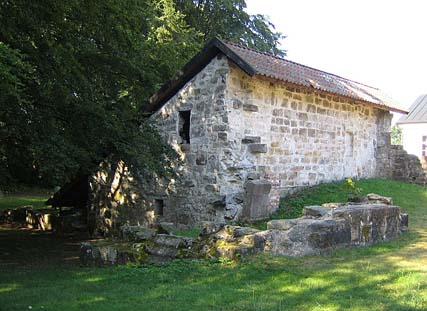
The Monastery of Herrevad, the first monastery for monks in Denmark

This chapel is the only remain of the monastery of Herrevad, the first monastery in Denmark, when Scania was part of the danish kingdom.

It was the archbishop of Lund, Eskil, who invited 12 monks and an abbot and some laymen to
Herrevad by the Rönne river to start a cicstercienser monastery for monks in 1144. They came from the cistersiencer monastery in  Citeaux in France. The laymen were farmers and crasftsmen and millers.

The Cistercienser orden was a practical working order, They were placed where there were good natural resources, hydropower, pastures, fishing, forestry and minerals. They were also missionairies and interested in arhcitecture.

Perhaps stoneworkers came fro Lund, when the cathedral was built and helped with the building of the monastery.

After the reformation the property was handed over to the danish magnate Sten Bille, uncle to Tyko Brahe, the famous danish astronomer, who spent a lot of time at Herrevad. Her he also saw Stella Nova

 Sten Bille together with Tyko Brahe constructed the first paperpress in the Nordic Countries 1570. Here the papermill, later called  "Klippan" started which still is active.

torsdag 13 september 2012

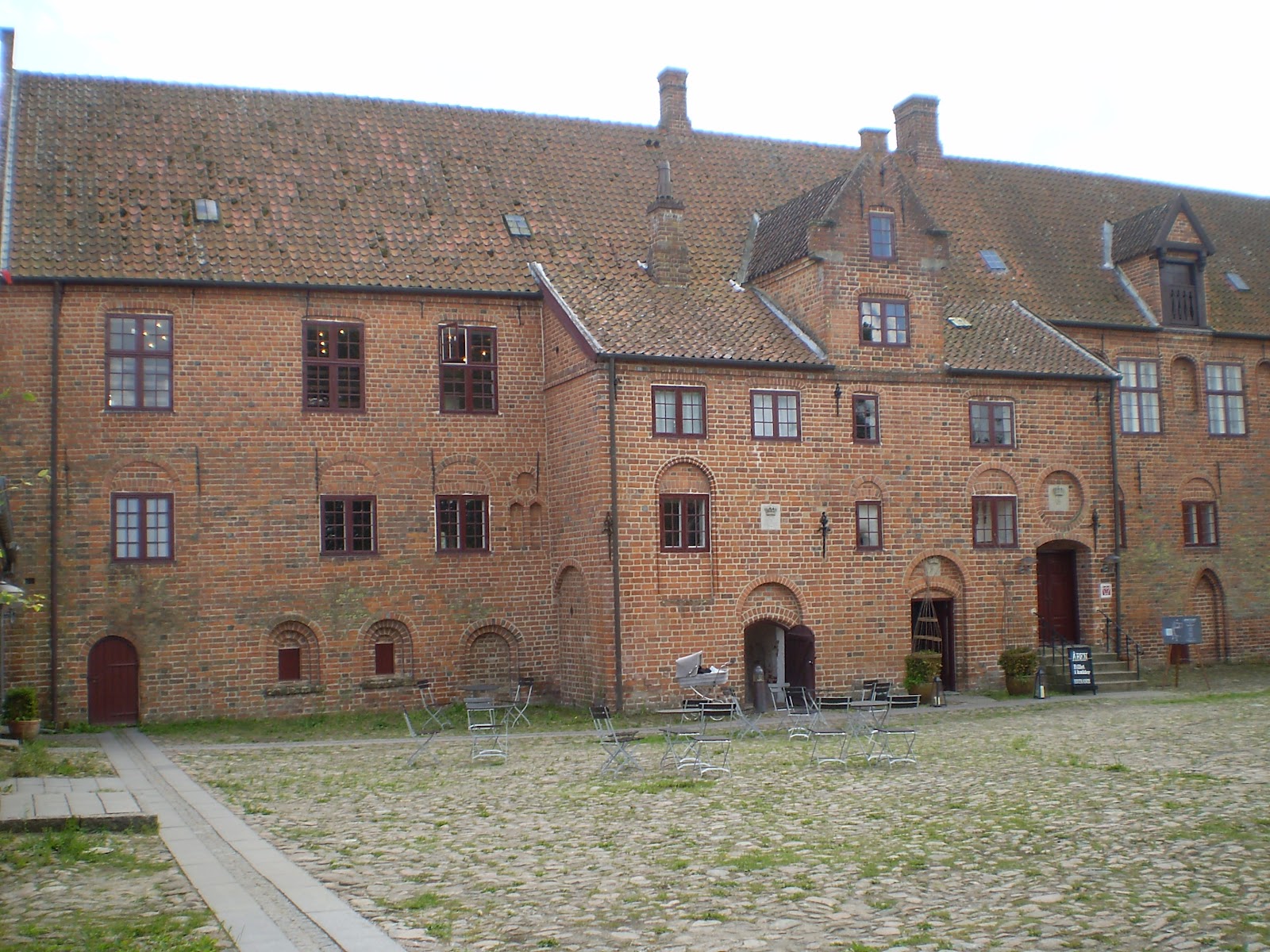
Esrum kloster

Esrum monastery in Zealand was constructed in 1151, after the monastery in Herrestad. Earlier here was a Benedictin monastery. It was the archbishop Eskol of Lund who took the initiative. Bernard of Clairvaux was a good friend of Eskil.

Esrum monastery became so rich och had such big influence, that by the time of the reformation it owned a third of all properties in norhern Zealand. After the reformation it was taken over by the Crown.

Today, the twostorey wing is what's left of the monastery. Today it's a very nice museum.

From the reformation to the 18th century it became a stud farm for the king.

It is open to week 42, thirsday to sunday- 10.30-16.30

During the winterseason, thursday to sunday- 11-16

söndag 9 september 2012

Fredriksborgs Castle on Zealand

 
Fredriksborg castle on Zealand in Denmark was built during the reign of Christan IV.
With it's baroquegarden, on of the finest in northern Eurospe, it is a lovely place to visit.
It is open from the 1 of november to the friday before the Palm sunday 11-15
The rest of the year 10-17.

It is placed at Hilleröd, close to Elsinore.
It was Fredrik II who took over a smaller property, and layed out channels for watersupply.
His son Christian IV, tore down most of the buildings and had a new magnificent castle built in dutch-danish renaissancestyle, probably with help from the builderfamily Steenwinckel.

In 1859 the castle was partly destroyed by fire, but rebuilt. The brewer J.C. Jacobsen, owner of the Carlsberg brewery payed for new inventories.

The castlechurch is the most magnificent churchroom from the renaissance time, in Denmark.

tisdag 4 september 2012

Harehunting on Ven, 1891, 5 september

On the Island Ven, in the middle of the Sound, between Seden and Denmark, hares were inplanted
1850-1877. The King had the huntingrights until 1917.

Hunting has always been important, during all times. On plenty of the old maps from teh 16th century there is always a hunter, some hares and other animals depicted.

From the middle of the 19th century the royal huntings dominated.

The most glorius hunt was on the 5th of september in 1891. In the huntingjournal it says:
Shot hares: 130, Number of shoots: 400, Number of hunters:28,  Hence the King: 12
Weather: Good, +19 Farenheit. Note: The Russian Tsar.

The swedish king Oscar II, had invited eleven royal guests. The guest of honor wa the russsian Tsar Alexander III. The others were Christian IX of Denmark, King Georg of Greece, the russian heir, later Emperor Nikolaus II, the english prince George, later king George V, the future danish kings Fredrik VIII and Christian X and the greek princes Nikolaus and Konstantin, who also became king
in due time.